

Recognising Excellence Across New Zealand
New Zealand Road Safety,
Emergency Response
and Healthcare Awards
Recognising people and organisations whose work helps prevent road trauma and supports people across emergency response, healthcare and recovery.
Nominations are free to enter
Closing 31 January 2027 at 11.59 pm

Welcome to the official page of the New Zealand Road Safety, Emergency Response and Healthcare Awards
Opening Addresses
A Message from the Chair
 John Barr
A Message from the Trustees
 Dr Darren Walton
 Jason Tippet
 Sarah Dean
Key Dates
Monday
Sunday · 11.59 pm
Thursday · 2.00 pm
Ceremony Venue Westpac Corporate Event Space, The Terrace, Christchurch
Recognise an Exceptional Contribution
Choose an Award Category
Submit a nomination through the online entry form, or download an application form for your chosen category.
Road Safety
Recognising outstanding professional achievement, innovation and contributions to improved road safety in New Zealand.
Emergency Response and Healthcare
Recognising exceptional response at a road crash site and excellence in road trauma care.
Community Service
Recognising exceptional assistance at a road crash site and support for a survivor through recovery.
Before You Begin
Prepare Your Nomination
Read the Official Awards Guide for complete eligibility requirements, assessment criteria and nomination guidance.
Three National Award Categories
Award Categories
The Awards represent a distinguished national standard of acknowledgement and recognition. Honours are presented across three national Award categories.
National Award for Emergency Response and Healthcare
This prestigious national Award recognises exceptional leadership, professional excellence and distinguished achievement in emergency response and healthcare for people affected by road trauma.
Honours may be presented in two areas of national recognition:
Exceptional Response at a Road Crash Site
Recognising an individual, team, organisation or multi-agency collaboration whose expertise, leadership and coordinated actions have delivered an exceptional response to a particularly significant road crash or series of crashes.
Excellence in Road Trauma Care
Recognising an individual, team or organisation whose innovation, professional leadership or sustained contribution has significantly advanced the quality, delivery or outcomes of care for people affected by road trauma.
Award Examples
Examples from the Application Form Guide include:
- Emergency rescue at a road crash site (Fire and Emergency New Zealand, New Zealand Police, Hato Hone St John and Air Rescue Services). A nomination may recognise an individual, group, team or organisation, or a joint response involving multiple services.
- Increased patient care capacity or patient care quality.
- Addressing an identified need, enhancing outcomes or improving a product, service, process or system that benefits people regionally or nationally.
- Enhancing or assisting in the further development of a product, service, process or system that benefits people regionally or nationally.
- Developing effective ways to minimise the impacts of disability or death after road trauma locally, regionally or nationally.
- Working with local, regional or national organisations to strengthen patient care or improve response times for road crash patients.
- Working with other organisations or agencies to improve response times.
- Applying unique skills or creative approaches to solve problems associated with the response to road trauma and people affected by it.
- Developing new services for population groups that traditionally struggle to access healthcare.
Adapted from the category application form for clarity. Please refer to the Official Awards Guide and application form for the complete criteria.
National Award for Road Safety
This prestigious national Award recognises outstanding professional achievement, innovation and leadership that has made a significant contribution to improved road safety in New Zealand.
Award Examples
Examples from the Application Form Guide include:
- A road safety project or programme that addresses an identified road trauma risk, such as improving a high-risk road layout or delivering a safer-driving education campaign.
- Innovative management approaches to overcoming workplace road safety challenges.
- Innovative interventions addressing an identified road trauma risk.
- Effective communication or marketing programmes or campaigns that promote safer roads and safer driving.
- Improved processes that significantly enhance road safety in planning, programming, project delivery, construction or maintenance.
- Strengthening capacity for infrastructure, roadworks site safety, construction quality, data management, performance tracking, monitoring and evaluation.
- Improvements that generate greater public awareness and a positive change in transport safety culture, such as community events or media publications.
- Addressing an identified need, enhancing an outcome or improving a product, service, process or system that benefits the wider community, particularly regionally or nationally.
- Road safety initiatives, schemes or products proven to contribute to improved road safety, particularly regionally or nationally.
Adapted from the category application form for clarity. Please refer to the Official Awards Guide and application form for the complete criteria.
National Award for Community Service
This distinguished national Award honours exceptional members of the community whose actions, compassion and service have made a significant difference to people affected by road trauma.
This Award may be presented in two areas of national recognition:
Assisting at a Road Crash Site
Recognising a member of the public whose courage, initiative or extraordinary assistance at a road crash site has significantly supported a person affected by road trauma.
Supporting a Road Crash Survivor Through Recovery
Recognising a member of the public whose exceptional service, commitment or support has made a significant contribution to the care, rehabilitation or recovery of a person affected by road trauma.
Award Examples
Examples from the Application Form Guide include:
- Assisting at a Road Crash Site
The National Award for Community Service may recognise a member of the public whose actions went above and beyond what could reasonably be expected of a bystander and made a significant difference to someone affected by a road crash.
There is no set formula. In general, a strong nomination will describe a series of actions that, taken together, demonstrate an exceptional contribution. For example, the nominee may have been first on the scene, called emergency services, helped keep the scene safe, provided first aid, and monitored and reassured an injured person who was drifting in and out of consciousness until help arrived. Staying with someone can be an important part of that response. On its own, it would generally be insufficient for this Award.
Describe what the nominee did, the circumstances they faced, and the difference their actions made. The actions being nominated must not qualify for a New Zealand Bravery Award.
- Supporting a Road Crash Survivor Through Recovery. Examples include providing sustained practical care or helping a road crash survivor access rehabilitation, regain independence or return to everyday activities.
Adapted from the category application form for clarity. Please refer to the Official Awards Guide and application form for the complete criteria.
Independent Review
Awards Executive Committee
The New Zealand Road Safety, Emergency Response and Healthcare Awards Executive Committee brings together respected professionals with expertise across emergency medicine, healthcare, road safety, engineering, community service and emergency response.
The Committee independently reviews nominations and makes recommendations for Award recipients.
Professor Mike Ardagh
Emergency Medicine Specialist
University of Otago
John Barr
Independent Chair
New Zealand Road Safety, Emergency Response and Healthcare Awards
Mark Bailey
Health Partner – Acute Services
Accident Compensation Corporation
Inspector John Fagan
Road Policing Manager: Northland
New Zealand Police
Peter Gallagher
Chief Advisor Operations
Fire and Emergency New Zealand
Ken Franklin
CEO and Independent Chair
HEMS New Zealand Ltd and HEMS Clinical Ltd
Professor Gary Hooper
Head of Department, Orthopaedic Surgery and Musculoskeletal Medicine
University of Otago (Christchurch)
Emeritus Professor Alan Nicholson
Road Safety Specialist
Civil and Natural Resources Engineering
University of Canterbury
Fabian Marsh
Strategy Director Safety
New Zealand Transport Agency Waka Kotahi
Scott Morris
Technical National Operations Manager
Hato Hone St John
Irene Tse
Technical Lead, Road Safety Engineering
Network Management
Auckland Transport
Nominations Close 31 January 2027
Help Recognise Exceptional Work
Know an individual, team or organisation whose contribution deserves recognition?
Our Awards History
The New Zealand Road Safety, Emergency Response and Healthcare Awards were formerly the Canterbury Road Trauma Awards. The Canterbury Road Trauma Awards were established in 2017.
Need Some Inspiration?
Explore previous Award recipients and the contributions recognised through the Awards.
Frequently Asked Questions
What are the Awards?
The New Zealand Road Safety, Emergency Response and Healthcare Awards recognise contributions by industry professionals in emergency services, hospital care, post-hospital care and road safety, and by members of the community who contribute to improved road trauma outcomes and may otherwise not be acknowledged.
The Awards are the nationalisation of the Canterbury Road Trauma Awards, which were established in 2017.
What are the Award categories?
There are three national Award categories:
- National Award for Emergency Response and Healthcare (formerly the Canterbury Road Trauma Award for Public Service).
- National Award for Road Safety (formerly the Canterbury Road Trauma Prevention Award).
- National Award for Community Service (formerly the Canterbury Road Trauma Award for Community Service).
Each category has its own eligibility requirements and assessment criteria. Review the Official Awards Guide and the relevant application form before preparing a nomination.
Who governs the Awards?
The Road Traffic Accident Trauma Charitable Trust trading as the National Road Trauma Centre governs the Awards.
The New Zealand Road Safety, Emergency Response and Healthcare Awards Executive Committee has responsibility for the Awards name, criteria and selection of Award recipients. The Committee brings together specialists from trauma medicine, orthopaedic surgery, risk management, emergency services and road safety.
What do Award recipients receive?
Award recipients receive a certificate and medallion in recognition of their meritorious efforts. These honours acknowledge their contribution to road safety, emergency response, healthcare or community service.
Who can apply?
Reviewing the Awards criteria and previous Award recipients can help you understand the range of contributions recognised, ranging from major trauma specialists, trauma nurses, forensic pathologists and emergency service personnel from Fire and Emergency New Zealand, Hato Hone St John, air rescue services and New Zealand Police, through to road safety specialists and a road safety entrepreneur. Recipients have been recognised for sustained work to prevent road trauma and reduce serious injury or harm, as well as exceptional assistance by members of the public at a road crash site. Eligibility depends on the criteria for the relevant category.
How are the Awards funded?
The Trust meets the costs of running the New Zealand Road Safety, Emergency Response and Healthcare Awards. It relies on support from Award sponsors and grants.
Members of the New Zealand Road Safety, Emergency Response and Healthcare Awards Executive Committee voluntarily contribute their time to the programme.
What media coverage do the Awards receive?
Receiving an Award can attract public and media attention. The Awards have received coverage across different media in previous years, helping to share recipients’ work and the contributions being made to road trauma prevention, emergency response, healthcare and community service.
May we use the official Awards logo for marketing purposes?
The Awards and Trust logos can be provided for marketing purposes. Their use must follow the Awards guidelines and terms of use.
Please request the official logo files and applicable guidelines before using them, so that the correct artwork and presentation are maintained. The contact details are provided in the More Help and Further Information section below.
What support is available during the submission process?
Help is available if you need guidance in preparing a nomination or have questions about the application process.
Start by reviewing the Official Awards Guide, the relevant category criteria and application form. These explain the information and supporting material required. If further guidance is needed, use the email address or phone number in the More Help and Further Information section below.
Does it cost to enter the Awards?
The Trust has ensured that the Awards are accessible to all. Neither the nominee nor the applicant or nominating person is charged to enter.
The Awards ceremony is by invitation only, and there is no charge to attend.
What are the benefits of being an Award recipient?
An Award recognises the contribution an individual, team or organisation has made and can strengthen recognition among peers, colleagues, other organisations and the wider public. A nomination itself acknowledges exceptional work.
The National Award for Emergency Response and Healthcare and the National Award for Road Safety recognise the hours individuals and teams have contributed to preventing road trauma and reducing serious injury or harm. Recognition can also contribute positively to employee satisfaction.
Some previous recipients have carried out exceptional work, day in and day out, over a long period without previously receiving recognition for that contribution.
Can one project or team be nominated for multiple categories?
Yes. If a project or programme fits more than one category, it may be nominated in each relevant category.
Read each category’s criteria carefully. The nomination needs to demonstrate how the project, programme or person meets the specific requirements of each Award category. Further guidance is available if you are unsure which category is appropriate.
Can multiple people nominate the same person or team?
Yes. The New Zealand Road Safety, Emergency Response and Healthcare Awards Executive Committee will be aware if a person or team has been nominated more than once.
The number of nominations received for the same nominee is not considered as part of the judging criteria.
Can the same organisation be nominated in more than one category?
Yes. Some organisations provide a range of services or work across several areas. Nominations in more than one category will be considered where each nomination meets the criteria for that category.
Each submission should clearly explain the relevant contribution and how it meets the requirements of the Award being sought.
What is the best way to encourage nominations?
Encourage colleagues, teams and organisations to identify and support suitable nominations. The Trust promotes the Awards to government and non-government organisations across healthcare, emergency services and road safety, as well as to members of the public.
Organisational management can take a proactive role in encouraging employees to put forward nominations. Working in partnership with other organisations to identify potential nominees has also been effective in previous years.
For the National Award for Community Service, relevant authorities and members of the public with knowledge of a road crash incident are encouraged to nominate people whose contribution may otherwise go unrecognised.
Do I need to advise the nominee they have been nominated?
It is not necessary to notify the nominee, but involving them before submission is recommended. This can help you prepare a stronger nomination by ensuring that the relevant details, evidence and contribution are accurately described.
Can you supply extra nomination information as appendices, links or graphics?
To ensure nominations are assessed fairly and impartially, all nominations must use the required application format. Follow the instructions in the relevant application form for supporting information and the applicable word limit.
For the National Award for Road Safety, supporting information should demonstrate the impact of the initiative in preventing road trauma nationally or regionally. Results from a post-implementation evaluation are preferable to an estimate prepared before implementation.
Further information may be requested from shortlisted nominees for promotional purposes after they have been announced. That material is not used as part of the judging process.
Are letters of support necessary?
National Award for Community Service: letters of support are compulsory and should support the nomination from a community perspective.
National Award for Road Safety and National Award for Emergency Response and Healthcare: management letters of support are compulsory. They should validate management endorsement and approval of the nomination from a business or organisational standpoint.
Additional letters of support for these two categories are not compulsory. Where included, they may come from a respected organisation with related interests or an individual able to provide a compelling account of the nominee’s contribution.
Letters of support help validate the nomination and the nominee’s credentials.
What should I consider when I solicit letters of support?
Provide the person writing the letter with enough background material to prepare an informed endorsement. Make sure they know the submission deadline and can provide the letter in time.
A strong letter of support should:
- Provide concrete examples supporting the nominee’s credentials.
- Outline key achievements, milestones or recognition.
- Explain the significance of the nominee’s work or its impact, including context that may not be apparent to someone outside the field.
- Provide evidence of the nominee’s contribution within their field, including the development of programmes or projects.
What detail should a strong letter of support include?
A focused, one-page letter that meets the nomination requirements should include:
- An opening paragraph introducing the nomination and nominee.
- A brief explanation of the writer’s relationship to the applicant or nominee, where relevant.
- A summary of the reasons for the nomination, referring to the Awards criteria.
- Relevant qualities and achievements of the nominee.
- Previous Awards or recognition, where applicable.
- A conclusion explaining why the nominee is a suitable candidate for the Award.
What is the deadline for nominations and are there extensions?
Nominations opened on Monday, 7 September 2026. The deadline for submitting nominations is 11.59 pm on Sunday, 31 January 2027.
Extensions are not available because time is required to shortlist and assess the nominations. Please allow enough time to complete the application and obtain all required letters of support before the closing date.
What if an Award recipient is unable to attend the ceremony in person?
If an Award recipient is unable to attend the ceremony in person, we can arrange a pre-recorded acceptance video so they can still be part of the occasion. Please let the Trust know in advance so that arrangements can be made before the ceremony.
More Help and Further Information
For further information or guidance in preparing a nomination, please contact the National Road Trauma Centre.
Email: sarah@nationalroadtraumacentre.org.nz
Phone: 027 324 0918
From Our Previous Ceremony
Previous Awards Programme
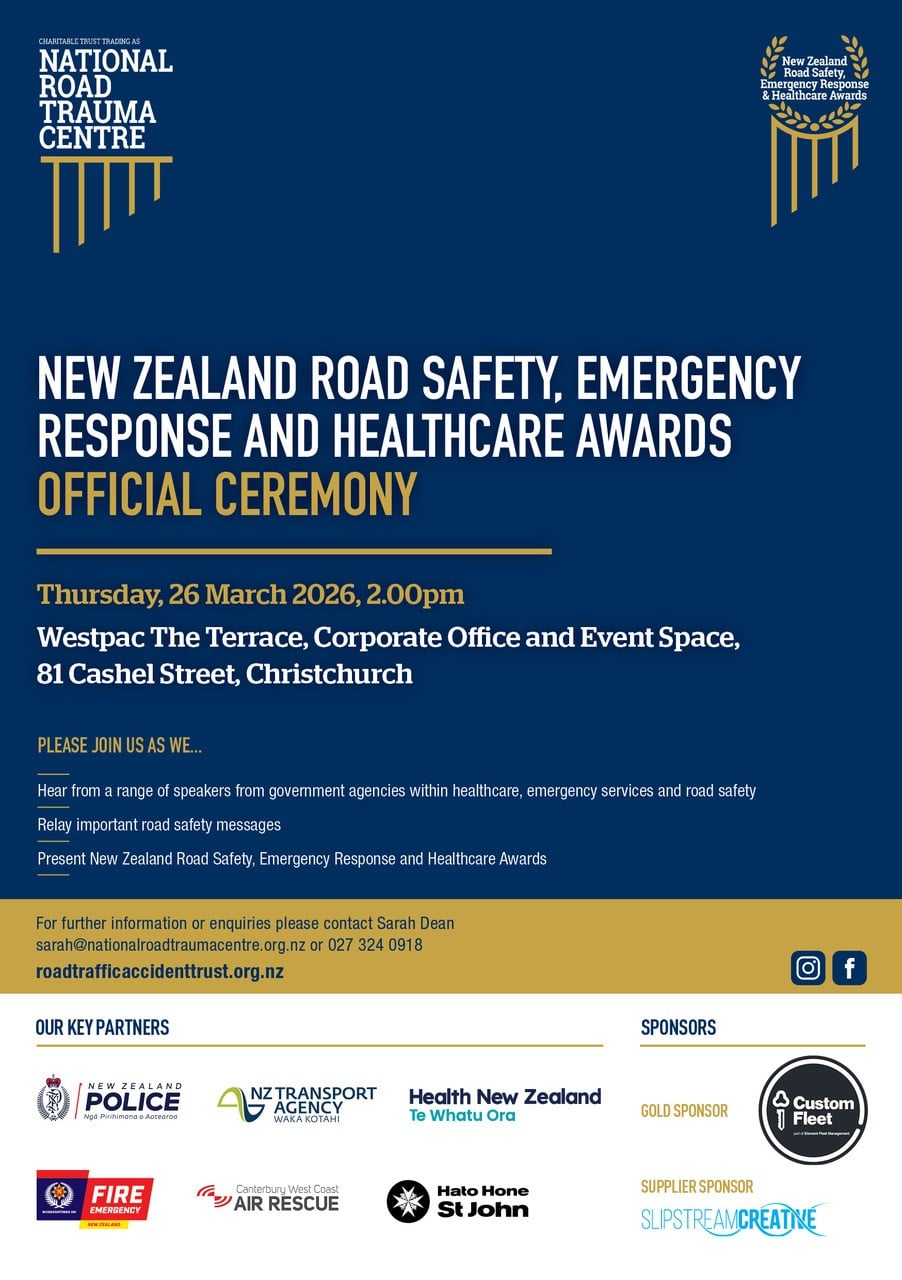
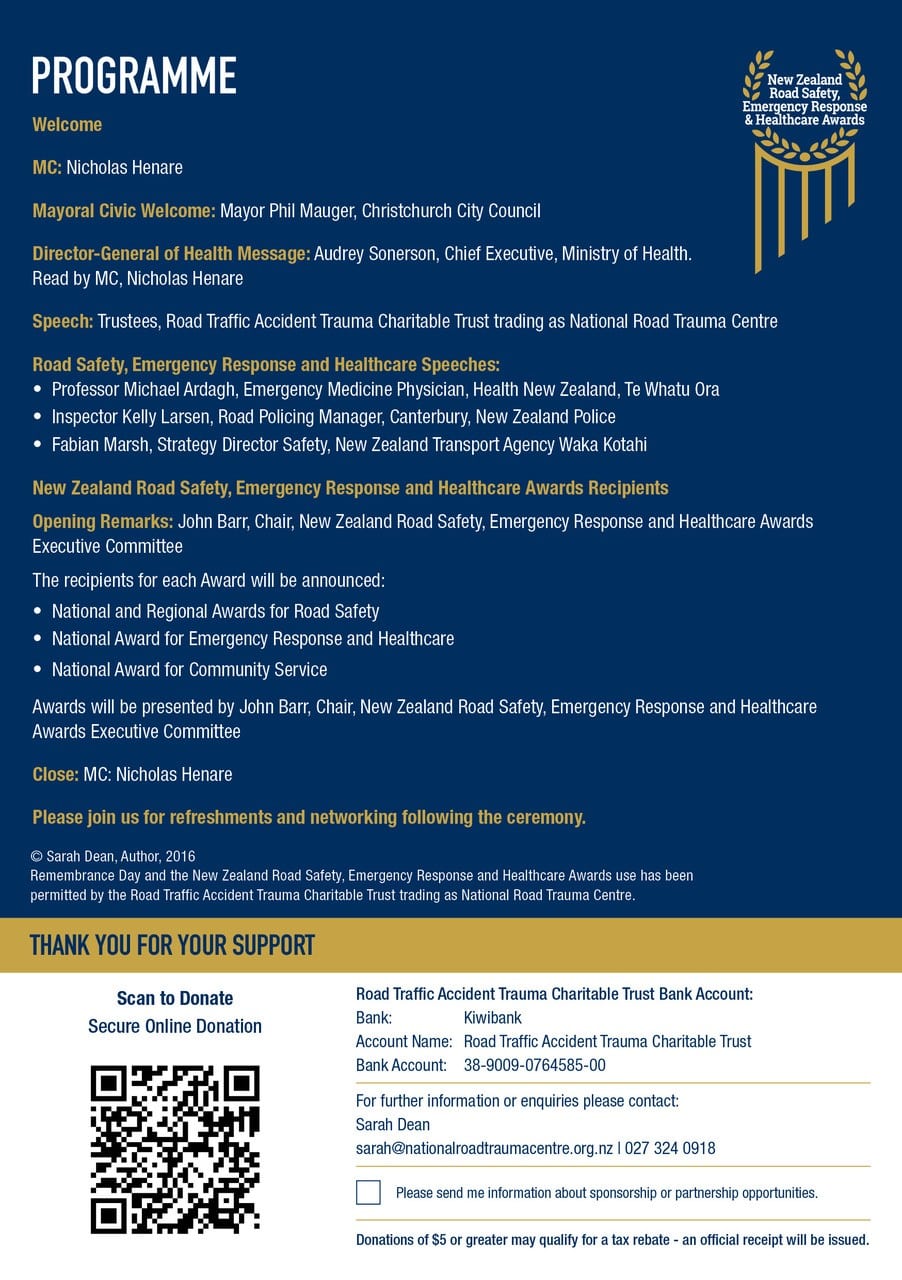
New Zealand Road Safety Emergency Response Awards Ceremony

Held March 2026, Westpac Corporate Event Space, Christchurch.