
Every Life Matters.

Chief Victim Advisor
1 November 2026 · Opening Address
Opening National Road
Trauma Awareness Month.
Tēnā koutou katoa
I am honoured to open New Zealand's inaugural National Road Trauma Awareness Month.
Today my thoughts are first and foremost with the survivors of road trauma, and with the families and whānau who carry its impact every day. For those who have lost loved ones, for those whose lives were changed in an instant, and for those who continue the long journey of recovery, this month is about recognising your experiences, your resilience and your strength.
Read the Full Opening Address
Road trauma is often measured in statistics, but behind every number is a person, a family and a story. The effects do not end when the crash scene is cleared. They can be felt for months, years, and sometimes a lifetime. This month gives us an opportunity to listen to those experiences, to acknowledge that reality, and to ensure that those affected know they are seen, heard and supported.
As we mark ten years since the first Road Accident Remembrance Day was established, I want to acknowledge the many people and organisations who stand alongside survivors and families. To our emergency responders, healthcare professionals, rehabilitation teams, victim support services, volunteers, advocates, and community organisations, thank you. Your compassion, commitment, and care help people through some of the most difficult moments they will ever face.
The five themes of this inaugural Awareness Month - prevention, remembrance, recovery, recognition and education, remind us that road trauma is not just about roads or vehicles. It is about people. It is about the lives that have been lost, the lives that have been changed and the communities that continue to support one another through grief, healing and hope.
For me, one of the most important purposes of this month is to ensure that survivors and families are not forgotten and that their experiences help shape a safer future for all New Zealanders. By sharing experiences, building understanding and strengthening awareness, we honour those affected and renew our commitment to preventing further harm.
As we approach the busy summer travel period, I encourage everyone to take a moment to reflect. Remember those we have lost, acknowledge those living with the consequences of road trauma and consider the role each of us can play in keeping ourselves and others safe on our roads.
Together, we can honour the past, support those affected today and work towards a future where fewer families experience the pain of road trauma.
Ngā mihi nui
Ruth Money MNZM
Chief Victim Advisor
Nau mai, haere mai · Welcome
Every life matters.
Every part of
the journey.
Connecting prevention, emergency response, healthcare and recovery across Aotearoa New Zealand.
Introducing Jack – The Data Tells a Story is our evidence-informed educational book. Follow a fictional young New Zealander through a road crash, emergency response, hospital care and recovery.
A Reader’s Perspective on the Book
“Behind every road-crash statistic is a human life, and the people who hold it close. Jack’s story brings that reality to life, reminding us that road trauma is never just about the crash, but the deeply personal challenges that follow.”
The Evidence Behind the Book
38 distinct published sources
New Zealand and international evidence informs the story and its educational context.
A breadth of expertise.
The project brings together expertise and input across:
- Research and road safety: data science, crash risk modelling, transport behaviour, statistical analysis, evaluation, driver training, vehicles and practical driving dynamics.
- Emergency response and emergency medicine: emergency medicine, critical care paramedicine, helicopter transport, vehicle extrication and wider clinical care.
- Psychological understanding and lived experience: clinical psychology, wellbeing, psychological medicine, and lived experience of pre-hospital and hospital care.
- Strategy, communication and digital delivery: weather intelligence and forecasting, artificial intelligence, data driven marketing, risk management, crisis detection, marketing and business analytics, evidence and audience research, digital strategy, campaign evaluation, audience testing, communications, content direction, project leadership and digital content creation.
The book also draws on published injury, health, trauma and rehabilitation evidence.
Our purpose · Tō mātou kaupapa
People at the centre.
A connected approach.
Our purpose is to support the reduction of serious road crashes and facilitate a patient centric care model that reduces the socio-economic impact of road crashes in New Zealand.
Road trauma affects lives well beyond the crash itself. Our work connects safer systems with a patient-centred approach across response, care and recovery.
We share knowledge, encourage collaboration and create opportunities for public education, professional learning and recognition.
About the National Road Trauma Centre
The road trauma journey
Before the crash.
Through care. Beyond hospital.
Different needs, connected by one purpose: reducing harm and improving understanding of the whole journey.
- 01
Prevention
Safer roads, speeds, vehicles and road use.
- 02
Emergency Response and Acute Care
From the first call through urgent treatment.
- 03
Hospital Care
Care that recognises the person behind the injury.
- 04
Primary Care, Rehabilitation and Recovery
Understanding changing needs after hospital.
- 05
Psychological Recovery and Wellbeing
Recognising the emotional and social effects of road trauma.
Recovery is individual and is not always linear. Physical and psychological needs can overlap throughout the journey.
A human story shaped by evidence
Introducing Jack.
The Data Tells a Story.
An ordinary journey. A moment that changes everything. An educational story connecting prevention, emergency response, treatment and recovery.
All Jack imagery is fictional and AI-generated. The story supports public education and is not individual medical advice or a prediction of anyone else’s recovery.
Watch Jack’s Story
Introducing Jack — The Data Tells a Story
Watch the supplied campaign reel, following Jack’s journey through road trauma, care and recovery. Jack is fictional and the illustrations are AI-generated.
November · Every year
Recognising the full
impact of road trauma.
National Road Trauma Awareness Month brings attention to prevention, response and recovery, while acknowledging survivors, those whose lives have been lost, and the enduring impact on whānau and communities.
Explore Awareness MonthKnowledge and resources
Clear information.
Informed conversations.
Our Resource Hub brings together information to help people explore the breadth of road trauma, from prevention and emergency response through to healthcare and recovery.
Visit the Resource HubFor individuals and whānau, schools, workplaces, counsellors and professionals.
Prevention and safe road use Emergency response and healthcare Rehabilitation, recovery and wellbeingGeneral educational information supports learning and does not replace individual medical advice.
Our strategic direction
Plan on a Page.
Our purpose, priorities and connected approach, brought together in the Centre’s existing strategic plan.
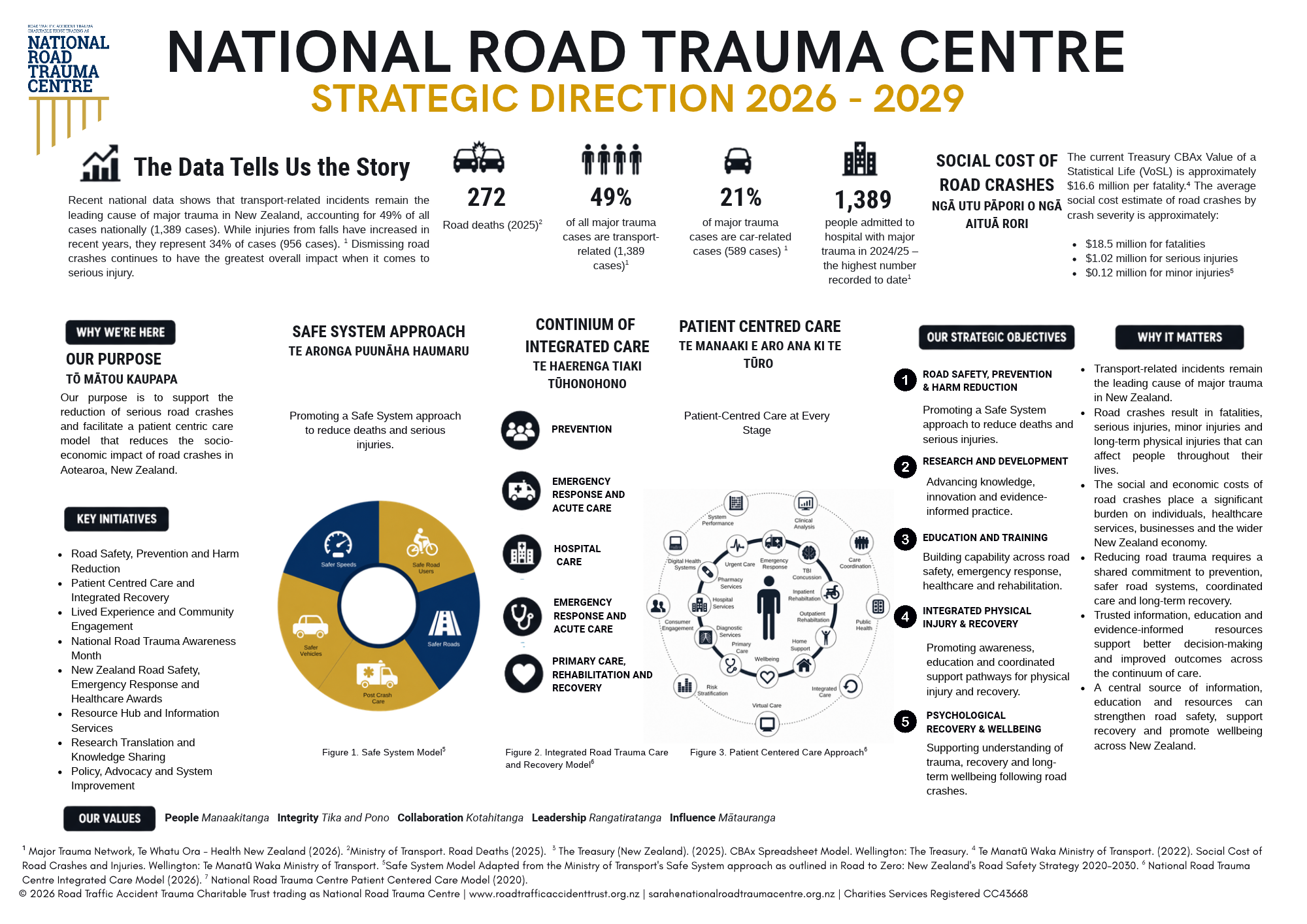 Open the full-size Plan on a Page
Recognition across Aotearoa
Recognising work
that makes a difference.
The New Zealand Road Safety, Emergency Response and Healthcare Awards acknowledge contributions across road safety, emergency response, healthcare and community service.
Watch the Awards Reel
A Legacy of Excellence Since 2017
Discover the New Zealand Road Safety, Emergency Response and Healthcare Awards, learn about their categories and explore the Roll of Honour recognising distinguished contributions since 2017. Earlier recipients were honoured through the Canterbury Road Trauma Awards, before the programme became national in 2021.
Explore the Awards and Roll of HonourRecipients recognised on 26 March 2026

National Award for Emergency Response and Healthcare
Twizel Medical Centre (PRIME team)
Recognised for their exceptional response to the July 2024 bus crash near Lake Pukaki.

National Award for Road Safety
Safe System Solutions Pty Limited, in partnership with New Zealand Transport Agency Waka Kotahi
Recognised for delivering structured, evidence-based Safe System training programmes across Aotearoa New Zealand.

Regional Award for Road Safety
South Canterbury Road Safety
Recognised for their leadership and commitment to improving road safety outcomes across the South Canterbury region.

Regional Award for Road Safety
Health New Zealand – Te Whatu Ora (South Canterbury)
Recognised for their leadership in public health and commitment to improving road safety outcomes across the South Canterbury region.

Archive · 26 March 2026
New Zealand Road Safety, Emergency Response and Healthcare Awards
We would like to sincerely thank and acknowledge everyone who joined us for the New Zealand Road Safety, Emergency Response and Healthcare Awards held in Christchurch on Thursday, 26 March 2026.
Read the full post
We would like to sincerely thank and acknowledge everyone who joined us for the New Zealand Road Safety, Emergency Response and Healthcare Awards held in Christchurch on Thursday, 26 March 2026. It was a meaningful afternoon that brought together leaders and professionals from across road safety, emergency response, and healthcare. Your presence reflected the strength of our collective commitment to improving outcomes for those affected by road trauma, and to continuing to strengthen the connections across the system, from prevention through to response, recovery, and care.
On behalf of the Road Traffic Accident Trauma Charitable Trust, trading as the National Road Trauma Centre, it was a privilege to recognise excellence across the sector.
We are proud to acknowledge this year’s award recipients:
- National Award for Road Safety: Safe System Solutions Pty Limited
- National Award for Emergency Response and Healthcare: Twizel Medical Centre (PRIME Team)
- Regional Award for Road Safety: South Canterbury Road Safety, and Health New Zealand – Te Whatu Ora (South Canterbury)
These organisations represent the very best of our sector, demonstrating leadership, innovation, and a deep commitment to safer outcomes for individuals, families, and communities across Aotearoa New Zealand.
We would also like to sincerely acknowledge our Gold Sponsor, Custom Fleet, whose support enables the recognition of excellence across road safety, emergency response, and healthcare. Your partnership is greatly valued. Our thanks also to the New Zealand Road Safety, Emergency Response and Healthcare Awards Executive Committee for their leadership, guidance, and ongoing support. Your commitment continues to shape and strengthen the Awards.
This year’s Awards were once again a powerful reminder that road trauma is not the responsibility of any one sector alone. It requires a coordinated, whole-of-system approach, and it is through collaboration such as this that we continue to make meaningful progress.
It has been a significant year, and we are incredibly grateful for the support, partnership, and shared purpose that continues to drive this work forward.
View original publication ↗Archive · 26 March 2026 ceremony
A message from the Director-General of Health
At the New Zealand Road Safety, Emergency Response and Healthcare Awards ceremony on 26 March 2026, Director-General of Health Audrey Sonerson acknowledged the National Road Trauma Centre, founder Sarah Dean and the Awards Executive Committee for their work…
Read the full post
Summary of Audrey Sonerson’s message, reworded for this website. This is not a verbatim quotation. The original message records the ceremony as 26 March 2026 and is dated 27 March 2026.
At the New Zealand Road Safety, Emergency Response and Healthcare Awards ceremony on 26 March 2026, Director-General of Health Audrey Sonerson acknowledged the National Road Trauma Centre, founder Sarah Dean and the Awards Executive Committee for their work to reduce road trauma and improve outcomes for those affected.
Her message recognised the professionalism, compassion and commitment of nominees and recipients across road safety, emergency response and healthcare. She highlighted the lasting difference their work makes to individuals, families and communities, often during times of profound vulnerability.
She emphasised that improving trauma outcomes requires a coordinated approach across prevention, emergency response, healthcare, rehabilitation and long-term recovery. Government agencies, first responders, clinicians, partner organisations and communities all contribute to strengthening trauma systems.
She congratulated all nominees and recipients and thanked them for their dedication to public service, community leadership and better outcomes for New Zealanders.
View original publication ↗

From the Centre
News and updates.
Archive · 11 September 2026
New road safety rules from 1 October 2026
The Road Traffic Accident Trauma Charitable Trust trading as National Road Trauma Centre welcomes changes to New Zealand’s road rules that aim to improve safety and better reflect how people use our roads.
Read the full post
The Road Traffic Accident Trauma Charitable Trust trading as National Road Trauma Centre welcomes changes to New Zealand’s road rules that aim to improve safety and better reflect how people use our roads.
Children aged 12 years and under will be permitted to ride bicycles on footpaths, with parents and caregivers able to accompany them.
- E-scooters will be permitted in cycle lanes.
- Drivers will be required to leave a minimum distance of 1.5 metres when passing other road users.
- Road users will be required to give way to buses leaving bus stops in areas with speed limits of 60 km/h or less.
These changes support a safer and more inclusive transport environment, particularly for children, cyclists, e-scooter users and people travelling by public transport.
The National Road Trauma Centre encourages everyone to become familiar with the new requirements before they take effect. Safer roads depend on shared responsibility, considerate behaviour and road users looking out for one another.
Further information is available from NZ Transport Agency Waka Kotahi.
View original publication ↗Archive · 3 September 2026
National Awards dates announced
The National Road Trauma Centre is pleased to announce the key dates for the 2026 New Zealand Road Safety, Emergency Response and Healthcare Awards.
Read the full post
The National Road Trauma Centre is pleased to announce the key dates for the 2026 New Zealand Road Safety, Emergency Response and Healthcare Awards.
The Awards recognise outstanding individuals, organisations and community initiatives that have made a significant contribution to road safety, emergency response, healthcare or support for people affected by road trauma in New Zealand. Nominations are welcomed from within New Zealand and internationally where the contribution has delivered a meaningful benefit to New Zealand.
- Nominations open: Monday, 7 September 2026
- Nominations close: Sunday, 31 January 2027
- Awards Ceremony: Thursday, 18 March 2027, Westpac The Terrace, Corporate Office and Event Space, Christchurch
Further information, including the Official Awards Guide, Award Criteria and nomination forms, will be available when nominations open on Monday, 7 September 2026.
View original publication ↗Archive · 12 June 2026
National Road Trauma Centre appears before Justice Committee
Today the National Road Trauma Centre appeared before the Justice Committee regarding the Sale and Supply of Alcohol (Improving Alcohol Regulation) Amendment Bill.
Read the full post
Today the National Road Trauma Centre appeared before the Justice Committee regarding the Sale and Supply of Alcohol (Improving Alcohol Regulation) Amendment Bill. The submission focused on the impacts of alcohol-related road trauma, including road deaths, serious injuries and the significant social, economic and wellbeing impacts experienced by individuals, families and communities throughout New Zealand.
The Centre acknowledged evidence presented regarding declining alcohol consumption trends and the increasing availability of low- and no-alcohol products. However, alcohol-related road trauma continues to result in preventable harm and remains an important road safety issue.
The submission also highlighted that while road deaths rightly receive significant attention, many more people survive crashes with serious and life-changing injuries.
The National Road Trauma Centre also acknowledged the many individuals affected by road trauma who have shared their stories, experiences and insights over many years. Their voices continue to contribute to greater understanding of road trauma in New Zealand.
View original publication ↗Archive · 8 June 2026
National Blood Donor Week 2026
National Blood Donor Week recognises the thousands of New Zealanders who generously donate blood and blood products to help save lives every day.
Read the full post
National Blood Donor Week recognises the thousands of New Zealanders who generously donate blood and blood products to help save lives every day.
For people seriously injured in road crashes and other major trauma events, donated blood can be a critical component of emergency care. Blood products support patients experiencing severe blood loss and are often required alongside emergency response, hospital care, trauma teams, and surgical treatment.
Recent national data from the New Zealand Trauma Registry shows that transport-related incidents remain the leading cause of major trauma in New Zealand, accounting for approximately 49% of all major trauma cases nationally. In 2024/25, New Zealand recorded 2,808 major trauma admissions, highlighting the ongoing importance of maintaining a safe and reliable blood supply to support trauma and emergency healthcare services.
To find out more, check your eligibility, or book a donation, visit nzblood.co.nz.
View original publication ↗Archive · 22 May 2026
$35 million investment into ambulance service initiatives
The Government has announced a $35 million investment into ambulance service initiatives across New Zealand to support frontline services, workforce capacity, infrastructure, technology upgrades, and increased operational capability across the emergency…
Read the full post
The Government has announced a $35 million investment into ambulance service initiatives across New Zealand to support frontline services, workforce capacity, infrastructure, technology upgrades, and increased operational capability across the emergency response and healthcare system.
Recent national data from the New Zealand Trauma Registry shows transport related incidents remain the leading cause of major trauma in New Zealand, accounting for approximately 49% of all major trauma cases nationally. Car related crashes accounted for 21% of all major trauma cases, while motorcycle incidents represented 12%.
Ambulance services are often the very first point of care for people experiencing serious injury. This recent Government announcement acknowledges both the importance of ambulance services and the critical work frontline ambulance teams undertake every day across New Zealand.
View original publication ↗Archive · Consultation closed 18 May 2026
Mental Health and Wellbeing Strategy consultation
Road trauma extends beyond fatalities and crash statistics.
Read the full post
Road trauma extends beyond fatalities and crash statistics.
Long-term physical injuries, psychological trauma, and recovery impacts also require greater recognition and coordinated support.
- Greater recognition of trauma-informed and patient-centred care
- Increased awareness of the psychological impacts of road trauma
- Improved integration across emergency response, hospital care, rehabilitation, and recovery
- Greater visibility of the long-term impacts of road trauma
- Recognition of lived experience across the continuum of care and recovery
- Opportunity to contribute to the consultation process and share experiences and insights
Consultation closes 18 May 2026.
For further information: https://consult.health.govt.nz/mental-health/consultation-mental-health-wellbeing-strategy/
View original publication ↗Archive · 4 May 2026
Privacy law update: what you need to know
A key amendment to the Privacy Act 2020 takes effect from 1 May 2026, introducing a change in how personal information is managed across New Zealand's health, emergency response, and support systems.
Read the full post
A key amendment to the Privacy Act 2020 takes effect from 1 May 2026, introducing a change in how personal information is managed across New Zealand's health, emergency response, and support systems.
This change introduced through the Privacy Amendment Act 2025 requires organisations to take reasonable steps to notify individuals when their personal information is collected from another agency.
If information about you is gathered from elsewhere in the system, you should now be made aware of it. This applies to personal information collected on and from 1 May 2026.
In the context of road trauma, information about an individual is often shared across multiple parts of the system including service providers, hospitals, and services across the health system responsible for treatment, care, and recovery, as well as support organisations involved in care and recovery.
What this means for practitioners
- Take reasonable steps to inform individuals when information is collected from another organisation.
- Ensure processes support transparency and clear communication.
What this means for individuals
- Greater awareness of how your information is collected and used
- The right to request access to your personal information
- The right to request correction of incorrect or incomplete information This change supports greater transparency across the system and may assist individuals and services to better understand how information is shared during care and recovery.
For more information on your privacy rights and how these changes may apply, visit the Office of the Privacy Commissioner at https://www.privacy.org.nz
View original publication ↗Archive · Effective 1 May 2026
Privacy law update: information sharing reminders
Under the Privacy Act 2020 (Privacy Amendment Act 2025).
Read the full post
Under the Privacy Act 2020 (Privacy Amendment Act 2025).
Your personal information may be shared between organisations. You should be informed if your information is collected from another organisation.
- Take reasonable steps to inform individuals when information is collected from another organisation.
- Ensure processes support transparency and clear communication.
- Greater awareness of how your information is collected and used.
- The right to request access to your personal information.
- The right to request correction of incorrect or incomplete information.
Applies to personal information collected on and from 1 May 2026.
For further information see the Office of the Privacy Commissioner: https://www.privacy.org.nz
View original publication ↗More from our existing homepage
Policy, research and people.
Archive · 23 March 2026
Transport-related incidents account for nearly half of all major trauma cases
Recent national data shows that transport-related incidents remain the leading cause of major trauma in New Zealand, accounting for 49% of all cases nationally (1,389 cases).
Read the full post
Recent national data shows that transport-related incidents remain the leading cause of major trauma in New Zealand, accounting for 49% of all cases nationally (1,389 cases). While injuries from falls have increased in recent years, they represent 34% of cases (956 cases), meaning road crashes continue to have the greatest overall impact when it comes to serious injury.
This information comes from the New Zealand Trauma Registry, which is part of a national system led by Health New Zealand I Te Whatu Ora. The registry brings together data from hospitals across the country, supported by partners including ACC and the Trauma National Clinical Network, to build a comprehensive picture of serious injury in Aotearoa.
Transport-related trauma includes people travelling in vehicles as well as more vulnerable road users. Car-related crashes make up 21% of all major trauma cases (589 cases), followed by motorcycle incidents at 12% (337 cases), with pedestrians and cyclists also contributing to serious injury outcomes. These figures reflect the everyday reality of risk on our roads and the wide range of people affected.
One of the reasons transport-related injuries remain so significant is the nature of these events. Road crashes often occur at speed and without warning, leading to more severe injuries and, in many cases, involving multiple people at once. Across New Zealand, 2,808 people were admitted to hospital with major trauma in 2024/25, the highest number recorded to date.
Beyond the immediate impact, these events can have lasting effects on individuals, families, and communities, while also placing considerable demand on emergency services, hospitals, and long-term rehabilitation support.
This highlights the importance of continuing to work together across prevention, emergency response, and ongoing care to reduce harm and support better outcomes for everyone affected.
View original publication ↗Archive · 2024/25 data
Major trauma by mechanism of injury
Number of cases, with percentage in brackets, by New Zealand region.
| Mechanism | Northern | Te Manawa Taki | Central | Te Waipounamu | National |
|---|---|---|---|---|---|
| Fall | 335 (37) | 162 (27) | 189 (37) | 270 (34) | 956 (34) |
| Struck by / collision with person or object | 81 (9) | 45 (7) | 44 (9) | 54 (7) | 224 (8) |
| Other | 87 (10) | 47 (8) | 34 (7) | 71 (9) | 239 (9) |
| Transport | 392 (44) | 353 (58) | 249 (48) | 395 (50) | 1,389 (49) |
| Car | 148 (17) | 171 (28) | 102 (20) | 168 (21) | 589 (21) |
| Motorcycle | 91 (10) | 103 (17) | 60 (12) | 83 (11) | 337 (12) |
| Pedestrian | 76 (8) | 19 (3) | 37 (7) | 41 (5) | 173 (6) |
| Pedal cycle | 64 (7) | 38 (6) | 36 (7) | 84 (11) | 222 (8) |
| Other transport | 13 (1) | 22 (4) | 14 (3) | 19 (2) | 68 (2) |
Source: Health New Zealand | Te Whatu Ora. (2026). Major Trauma Annual Report 2024/25. New Zealand Trauma Registry, p. 19.
View original table ↗Archive · 25 February 2026
Lane Use Improvements consultation
The NZ Transport Agency (Waka Kotahi) is consulting on proposed lane use improvements as part of a wider review of New Zealand’s land transport rules.
Read the full post
The NZ Transport Agency (Waka Kotahi) is consulting on proposed lane use improvements as part of a wider review of New Zealand’s land transport rules. The purpose of this consultation is to ensure that lane-use regulations remain fit for purpose, reflect how people travel today, and support a safer and more efficient transport system. As travel patterns evolve and new transport modes become more common, the rules governing how lanes are used need to be updated and clarified.
The consultation is seeking feedback on several key proposals, including clarifying the rights and responsibilities of different road users, updating lane-use rules to better reflect current travel behaviours, allowing e-scooters and similar low-powered vehicles to use cycle lanes where appropriate, introducing minimum overtaking gaps when motorists pass cyclists and other vulnerable road users, and requiring certain vehicles to give way to buses re-entering traffic from bus stops.
The consultation closes on 25 March 2026. Full details, supporting documents, and information on how to make a submission are available on the NZ Transport Agency (Waka Kotahi) Public Consultation Hub at https://www.nzta.govt.nz/about-us/public-consultation-hub/current-consultations/.
View original publication ↗Archive · 24 February 2026
Awards nominations
The Awards Executive Committee for the New Zealand Road Safety, Emergency Response and Healthcare Awards will meet on Friday, 27 February 2026 to carefully consider this year’s nominations.
Read the full post
The Awards Executive Committee for the New Zealand Road Safety, Emergency Response and Healthcare Awards will meet on Friday, 27 February 2026 to carefully consider this year’s nominations.
We extend our sincere thanks to everyone who has taken the time to prepare and submit nominations for the New Zealand Road Safety, Emergency Response and Healthcare Awards. The quality and depth of submissions received this year reflect the extraordinary leadership, service and commitment demonstrated across road safety, emergency response and healthcare throughout Aotearoa New Zealand.
This stage of the process is undertaken with great care and integrity, reflecting the responsibility of recognising excellence across road safety, emergency response and healthcare throughout Aotearoa New Zealand.
Nominators can expect to be formally advised of outcomes no later than Monday, 2 March 2026.
View original publication ↗Archive · 24 February 2026
New Trustee appointment, Dr Darren Walton
On behalf of the Trust, it is with great pleasure we announce our most recent Trustee appointment, Dr Darren Walton, PhD, a nationally respected research leader, data scientist and evaluation specialist whose work has shaped public policy and system performance across transport, justice, health and policing in Aotearoa New Zealand.
Read the full post

On behalf of the Trust, it is with great pleasure we announce our most recent Trustee appointment, Dr Darren Walton, PhD, a nationally respected research leader, data scientist and evaluation specialist whose work has shaped public policy and system performance across transport, justice, health and policing in Aotearoa New Zealand. As Director of Crow’s Nest Research and Adjunct at the University of Canterbury in Psychology and Criminal Justice, Dr Walton brings more than two decades of applied research, national data analysis and evidence based policy development.
Dr Walton’s expertise spans national data analysis, advanced statistical modelling, Treasury-level business case development and cost benefit analysis, and rigorous monitoring and evaluation using large administrative datasets. His work has supported the Ministry of Transport, New Zealand Police, Ministry of Health, NZ Transport Agency (Waka Kotahi) and other agencies to strengthen evidence informed decision making at a national level.
Dr Walton’s work spans prevention, response and recovery across the road trauma continuum. His expertise in road safety research, crash risk modelling and transport behaviour strengthens the evidence that informs safer systems. Using national data and robust evaluation methods, he helps identify where risk sits and how systems can respond more effectively, supporting stronger alignment between prevention strategies, frontline response and long term recovery.
View original publication ↗Archive · 25 January 2026
New Trustee appointment, Jason Tippet
On behalf of the Trust, it is with great pleasure we announce our most recent Trustee appointment, Jason Tippet. Jason is an emerging leader who brings thoughtful governance insight, cultural depth and a strong commitment to public service to his role with the Trust.
Read the full post

On behalf of the Trust, it is with great pleasure we announce our most recent Trustee appointment, Jason Tippet. Jason is an emerging leader who brings thoughtful governance insight, cultural depth and a strong commitment to public service to his role with the Trust.
He is of Ngāi Tahu descent and is affiliated with Te Taumutu Rūnanga. Grounded in te reo Māori and kaupapa Māori values, Jason brings a lived understanding of kaitiakitanga, guardianship and intergenerational responsibility. His leadership reflects a strong commitment to protecting people, whenua and community wellbeing.
Jason is also a weather forecaster (matapae huarere), with a strong interest in interpreting and communicating environmental information. This analytical, systems and evidence based perspective complements his contribution to governance and strategic thinking within the Trust.
He has contributed to the Trust’s policy and advocacy work, including supporting the development of a submission relating to emergency legislation. His involvement demonstrates a clear understanding of accountability, system improvement and the importance of ensuring that the voices of those impacted by road trauma are represented within national discussion.
View original publication ↗Archive · 22 January 2026
ACC reform, strategy and accountability framework
ACC has today released its new Strategy 2026-2029, alongside its Statement of Intent 2026-2030, Service Agreement 2025/2026, and Letter of Expectation, outlining how it will deliver its performance turnaround over the next four years.
Read the full post
ACC has today released its new Strategy 2026-2029, alongside its Statement of Intent 2026-2030, Service Agreement 2025/2026, and Letter of Expectation, outlining how it will deliver its performance turnaround over the next four years.
These documents serve different but complementary purposes:
- Their Strategy 2026-2029 sets the long-term direction and priorities for strengthening rehabilitation outcomes and financial sustainability.
- Statement of Intent 2026-2030 outlines ACC’s medium-term objectives, performance measures, and accountability commitments to Government and the public.
- Service Agreement 2025/2026 details the operational expectations, funding parameters, and service delivery targets for the coming year.
- Letter of Expectation provides guidance from the responsible Minister, setting strategic priorities and performance expectations for ACC.
Together, these documents provide transparency around how ACC intends to improve timeliness, service coordination, financial management, and prevention investment. For road crash survivors, this framework matters because it sets clearer expectations for faster access to care, stronger rehabilitation outcomes, and greater accountability for how ACC supports recovery.
View original publication ↗Archive · 19 January 2026
New appointment, John Barr
On behalf of the Trust, it is with great pleasure we announce our most recent appointment: John Barr, Chair of New Zealand Road Safety, Emergency Response and Healthcare Awards Executive Committee.
Read the full post
On behalf of the Trust, it is with great pleasure we announce our most recent appointment: John Barr, Chair of New Zealand Road Safety, Emergency Response and Healthcare Awards Executive Committee.
John Barr serves as Chair of the Awards Executive Committee for the New Zealand Road Safety, Emergency Response and Healthcare Awards. He is a respected business advisor with Ayrshire e.b.a. and currently holds several senior governance roles, including Chair of Canterbury Scientific Ltd and President and Director of St George’s Hospital Society. He also chairs multiple healthcare advisory boards and supports governance projects and mentoring initiatives nationally.
John brings extensive board-level experience across healthcare, pharmaceutical manufacturing, scientific, and community sectors. His breadth of governance expertise, commercial insight, and commitment to strong ethical leadership provide valuable strategic oversight to the Awards programme, supporting its continued national development and reinforcing its credibility across road safety, emergency response, and healthcare sectors throughout New Zealand.
View original publication ↗Archive · 20 November 2025
Expanded nurse practitioner prescribing powers
In November 2025, the New Zealand Government announced changes under the Medicines Amendment Act to expand nurse practitioner (NP) prescribing powers, improving access to patient-centred primary care for people recovering from road crashes.
Read the full post
In November 2025, the New Zealand Government announced changes under the Medicines Amendment Act to expand nurse practitioner (NP) prescribing powers, improving access to patient-centred primary care for people recovering from road crashes.
Key updates include:
- NPs can now prescribe a wider range of medicines, including alternatives during shortages + Faster access to essential medications, reducing delays in primary care * Fewer GP visits and more coordinated care tailored to individual patient needs
Road crash survivors often require ongoing support for injuries such as sprains, whiplash, fractures, and cuts. In 2024, ACC recorded 35,676 new road crash injury claims, with an average cost per claim of $14,500. Expanded NP prescribing powers help manage both physical and psychological recovery by coordinating care with physiotherapists, primary health care providers, and community services.
The Trust supports this patient-centred approach. These changes are designed to provide timely, accessible care, particularly for patients in rural or underserved communities.
View original publication ↗Archive · 11 November 2025
New roadside testing to tackle drug-impaired driving
The Government has announced a new oral-fluid roadside testing programme, an important step toward reducing road harm and saving lives.
Read the full post
The Government has announced a new oral-fluid roadside testing programme, an important step toward reducing road harm and saving lives. Under the new programme, Police will be able to stop any vehicle at any time to screen for THC (cannabis), Methamphetamine, MDMA (ecstasy) and Cocaine.
The rollout will begin in Wellington this December, expanding nationwide by mid-2026. This programme aims to strengthen how New Zealand tackles drug-impaired driving — through better enforcement, education, and accountability — to make our roads safer for everyone.
Serious crashes do not just affect those directly involved. The grief, trauma, and disruption extend to bystanders, first responders, the wider community, and our healthcare system. Every crash prevented means fewer hospitalisations, less trauma for responders, and fewer families left grieving.
View original publication ↗Stories and perspectives
Current affairs · Ngā Kōrero Wā
Warrant of Fitness Changes: Keeping Your Vehicle Safe Between Inspections
Changes to New Zealand’s warrant of fitness (WoF) requirements begin today, with longer inspection intervals for some vehicles.
Read More
What is changing?
- New light vehicles: the second WoF is due after four years, rather than three.
- Eligible light vehicles aged four to 14 years: two-yearly inspections are being introduced in stages. From 1 November 2026, this applies to vehicles first registered on or after 1 November 2019. Vehicles first registered between 1 November 2013 and 31 October 2019 follow from 1 November 2027.
- Older vehicles: vehicles previously requiring six-monthly WoFs move to annual inspections. Those already requiring annual inspections continue on that schedule.
- Light rental vehicles: Certificate of Fitness A inspections move from six-monthly to annual.
Your current expiry date does not change. The new inspection interval applies at your next inspection. Checks also now cover warning or malfunction indicators for relevant advanced driver assistance systems, where fitted.
Vehicle safety remains an everyday responsibility
A current WoF does not replace ongoing maintenance. Vehicle owners remain responsible for keeping their vehicles safe between inspections. Check tyres, lights and other safety equipment regularly, and arrange repairs promptly when problems arise.
Keeping your vehicle safe helps protect you, your passengers and everyone sharing the road.
Check the Requirements for Your Vehicle with NZ Transport Agency Waka Kotahi
Source updated:
Average Speed Cameras: Understanding the Changes
Average speed cameras measure a vehicle’s speed over a stretch of road, using the time taken to travel between two cameras.
Read More
NZ Transport Agency Waka Kotahi is introducing average speed cameras at locations around New Zealand. Installation, testing and enforcement can happen at different times, so a camera being installed does not necessarily mean it is issuing notices.
NZTA’s site list, updated on 27 October 2026, lists State Highway 8 between Lake Tekapo and Twizel as enforcing. Other locations are at different stages of development.
NZTA installs average speed camera area signs before enforcement begins. Where cameras are not yet operating, camera not in use signs may be displayed.
The date above refers to NZTA’s source update, rather than a single nationwide launch. Check its current site list for locations and operating status.
Improving Access to Rehabilitation After Major Trauma
The path of making things right: Te ara whakatika is a national project focused on improving access to rehabilitation after people leave hospital following major trauma.
Read More
The project runs from July 2025 to June 2027. It is a partnership between Health New Zealand | Te Whatu Ora, ACC and the Health Quality & Safety Commission Te Tāhū Hauora, funded by ACC.
A particular focus is addressing inequities for Māori, who are disproportionately affected by major trauma but can face slower and reduced access to ACC and rehabilitation services.
The work brings together clinical teams, rehabilitation and community providers, kaupapa Māori services and lived experience to reduce barriers, strengthen partnerships and share improvements across New Zealand.
Archive · By Ellen Lovegrove
Nicholas Henare
Nicholas Henare was nineteen when his life changed in a second.
Read the full post
Nicholas Henare was nineteen when his life changed in a second.
A split second of divided attention and a late reaction to a corner was all it took for the then Sony Music Executive to experience a devastating crash, permanently altering the course of his life.
“I ended up breaking nearly every bone in my body. If it wasn't for a first responder who found me, and I was literally down the road from the hospital, I wouldn't have made it," recalls Henare.
Henare is now a real estate agent, the latest in a long line of varied and exciting careers, and rarely talks publicly about the crash that nearly ended his life. He said that many people in his life are unaware that it happened. But he believes stories like his matter, especially for people like him navigating the same daunting road to recovery.
“I am one of very few who came out of an accident like that and actually live."
Henare was on his way to a business meeting when the crash happened. “I was changing the tape in my car looking down for just a second,” he admits, “and I just didn't take the corner, it was just that simple.”
According to Waka Kotahi NZ Transport Agency, 2,453 people were seriously injured in road crashes in 2023. Survivors like Henare are often left with a long road to recovery, not only physically but also mentally.
“Looking back on it, I definitely had post-traumatic stress disorder for a couple of years. At the time, I really struggled with figuring out who I was.”
Henare spent two weeks in a coma, followed by eight months in hospital, where he formed deep bonds with hospital staff. “I wasn't expected to live. I was very lucky that I had a great team of doctors and hospital support crew.”
But once discharged, reality hit hard. “I'd gone from being a pretty high-flying guy, you know, nice cars and nice houses and great job, to flatting and just figuring out who I was again." At just 24 years old, he found himself having to rebuild his life from the ground up. “I was hobbling around and trying to get up to my second-story flat, which was really hard. I was out of work and living on ACC, and my whole life changed.”
When asked what his advice would be to other survivors in his position, Henare keeps it simple. “Take your time. I rushed to get back to where I'd been, but you just aren't there anymore. Just relax and don't stress."
"My biggest advice would be to talk to people. Whether it's a counsellor or a family member or it's just a bloody good friend.”
While New Zealand's Safe System approach to road safety has made significant improvements in overall road safety, Henare is realistic. “We've come a long way, but sometimes an accident is an accident. The roading is so much better than it used to be, but accidents are just what happens.”
While a crash like Henare’s might be expected to put a survivor off driving, it actually pushed him into the driving seat. While working in radio and television, he got a chance to review a Ferrari 458, which led him to a role working around the world with BMW. “I don't let the accident scare me, I still drive on motorways and I still have a fast car - I love it.”
These days, his life is as dynamic as ever. This weekend, Henare is judging an international BBQ competition. Tonight, he is off to a wool fashion show. “I'm in real estate full time, and | still do MC work for causes I care about like the upcoming New Zealand Road Safety, Emergency Response and Healthcare Awards."
Henare is particularly passionate about giving back. “What you give out is what you get back. That's why I always say yes to charity work. And if being the MC at an awards night helps even one survivor feel seen, then I'm doing something right.”
That's why he believes initiatives like a National Road Trauma Centre could be invaluable. “At the time, I wouldn't have wanted to face it. But looking back, having a place where people understand what you're going through? That could change lives."
He pauses. “People don't realise how hard it is until they're living it. And even your best friends, even if they've watched you go through hell and back, they still won't truly get it.
Thirty years on, Henare lives with both the scars and the strength forged from his crash. “The accident was tragic and awful, but at the end of the day, you can't let it stop you from living your life. I appreciate life more than ever.”
He hopes that by sharing his story, others will find hope in their own recovery.
"You've got to go for what you want,” he says. “Because in 1993, I learned the hard way that you might be here today, and gone tomorrow."
View original publication ↗Archive · By Jordan Smith
Stay Alive on 5 campaign sees unprecedented success
Motivation to create change comes in many forms, but for Sergeant Steven Knox, it came with a tragic undertone.
Read the full post
Motivation to create change comes in many forms, but for Sergeant Steven Knox, it came with a tragic undertone.
When he was just a teenager, Knox's good friend was killed by a drunk driver. From then, he vowed he would spark the change.
“I made a graveside promise that I'll join the police one day and make a difference,” he said.
At age 40, Knox joined the force and road police shortly after to honour that promise, with his main deployment being State Highway 5 in the North Island. He and his team had "started to notice a trend of fatalities increasing” in the late 2010s, so in 2020, he decided it was time to take action.
“Here I am thinking ‘this is my opportunity to do something good for the community, but also, it lives my graveside promise I made to my friend that I'll make a difference."
From there, Knox got in contact with police officers, both the Taupo and Hawke's Bay Councils, Waka Kotahi and contractors, and thus, ‘Stay Alive on 5’ was born.
The campaign encompassed many changes, with road safety billboards and electronic signs urging motorists to slow down and alerting them to tight corners put in place.
Additionally, police presence increased on the road, with both marked and unmarked patrol vehicles working in tandem as well as utilising speed camera vans.
The results speak volumes to his work.
In the 20 months prior to the campaign, SH5 had seen 13 fatalities along with 183 accidents, totalling at a social cost of over $84 million dollars.
The first 20 months of Knox’s campaign? Not a single fatality.
Only 81 crashes were recorded, with two being serious, only costing $3.5 million. Four years later (2020-2024), there were only two fatalities recorded, lower than the four-year period prior to the campaign's implementation.
Even Kiwi motorsport legend and Hawkes’ Bay native Greg Murphy took notice, as Knox said he called him “out of the blue”.
“[He] said 'I've been seeing the good work that's been going up there that you've been driving’.
"He said that he'd like to use his media platform to promote the good work as well... on his reach he's got a few thousand I believe from my last look."
Off the back of some truly remarkable mahi, Knox was awarded with the National Award for Road Safety in 2024. The acknowledgement recognises achievements made by individuals and/or organisations that improve road safety through excellent practice, design or technical application.
“I was quite chuffed because it's a big thing. I hadn't been nominated before for any national award, so it was pretty cool,” Knox said.
“We don't do the job for awards, but it was nice to get a pat on the back.”
He exemplified rubbing shoulders with large organisations such as Auckland Transport left him feeling a strong sense of pride and accomplishment that he'd made that promise cast many moons ago a reality.
"It was a very good event, and I felt quite humbled,” he said.
“I thought in my mind ‘yeah, I've done a good job. I'm happy’.
Like many of his fellow award winners, Knox whole-heartedly backed the importance of the award's existence, as he said it helps celebrate people doing "some fantastic work out there."
"To get people put forward for any recognition is huge, because not a lot of people get a pat on the back and it's very nice when you do, especially at that level.”
He also praised the simplistic nature of the nomination-to-award process, highlighting how "to write what I needed to put forward for the whole process was fairly easy.”
Knox strongly encouraged those out there doing it to nominate others, saying there's no feat too small.
It doesn't have to be huge things... if it's done good by the community to do with road safety and the results are showing, put through a nomination.”
“Don't be afraid to give someone a pat on the back because I reckon that's a good place to be."
Looking forward, Knox hopes to implement a similar campaign on State Highway 2 due to a rise in fatalities, and possibly beyond.
“Obviously I can't brand stay alive on five down there because five doesn't rhyme with two," he said laughing.
“I'm quite keen to go to the National Road Police Headquarters in Wellington with everything on this and say ‘hey, this could be a good template or resources that are going to be very helpful for other people around the country.”
View original publication ↗Archive · By Jordan Smith
Truck driver who saved woman’s life honoured
In his words, truck driver Michael Baty was “just doing his part”. In reality, he saved Colleen Reid’s life.
Read the full post
In his words, truck driver Michael Baty was “just doing his part”. In reality, he saved Colleen Reid’s life.
After her car flipped over driving along Nevis Bluff on State Highway 6, Reid was unnoticed by passers-by for 24 hours. The crash had left her car hidden by dense bush, leaving her trapped in her own vehicle, unable to communicate for help.
Baty, who had seen posts on Facebook and Police articles that Reid had disappeared, remained vigilant on his commute. From his elevated position, he spotted Reid, and after calling 111, waited with her until emergency services arrived.
In those precious minutes, Baty provided her with reassurance and comfort as they held tight for help.
According to the Cromwell man, it was “literally only two minutes” until police arrived on the scene after he had alerted them, and another three for the rescue helicopter.
“There was a lot of adrenaline and shock that she was alive. Having her look up at me is a feeling I can't describe," Baty said.
As a result of his actions, Baty was nominated and subsequently the winner of the National Award for Community Service in 2024, an honour that recognises members of the community who have provided outstanding care or support to a road trauma victim.
When asked what it meant to him, Baty said he was "shocked and privileged” for the award and lamented that he's "just a genuine bloke."
“I didn't expect anything for it; I was just doing my part.”
Baty may have believed he just did what any person would do, but when Area Road Policing Manager Steven Watt got wind of the award's existence, he didn't think twice to nominate the selfless truck driver.
“I instantly thought of Michael and thought ‘what a well deserving person for this award”, Watt said.
“It was a simple form document that I had to fill out. [It] didn't take much time at all, and it was quite well set out and informative.”
Watt said this kind of award holds an incredible amount of significance, especially when regarding Kiwi's tendencies to shy away from the spotlight.
“We're a country of humble people. We don't like to be recognised, and we don't like to push people forward to be recognised for extraordinary acts."
"I think we have to get past that humility and go ‘you know what, these are deserving people’. We need to step up and show the country and show others that we do have exceptional people out there and rightly recognise them through awards." However, the impact of the award doesn't just end at celebrating the individual.
In a sector such as road trauma and transportation in general, the narrative is dominated by negative, dreary headlines.
There's good reason for that too. In a 2022 study conducted by the Australian Government, New Zealand ranked fourth highest out of the 31 OECD countries in terms of road deaths per 100,000.
While those statistics demonstrate New Zealand's roads do face problems, Watt said recognitions such as the Community Service Award celebrates examples like Baty's that are setting a new precedent for how the sector is viewed.
“It's important to not ignore the negative but instead focus on the positive and build on that.”
“I don't want to take away from the trauma but there is a lot of really good stuff that happens on our roads. Whether it be an example like Michael's or the engineering of roads or new initiatives... It's not all bad."
View original publication ↗Archive · By Jordan Smith
Auckland Transport awarded for groundbreaking Safe Speeds programme
In 2017, Auckland Transport's (AT) Head of Road Safety Engineering, Michael Brown said they had recognised a “real issue” with deaths and serious injuries on their roads. A 70% increase of both categories since 2014 confirmed the issue.
Read the full post
In 2017, Auckland Transport's (AT) Head of Road Safety Engineering, Michael Brown said they had recognised a “real issue” with deaths and serious injuries on their roads. A 70% increase of both categories since 2014 confirmed the issue.
Instead of providing excuses, Brown and his team acted, introducing the ‘safe speeds’ programme in 2020.
The programme centred around lowering road speeds and setting more appropriate limits, initially starting on rural roads and reducing speeds in the City Centre.
The results speak for themselves.
“[On] higher speed, rural roads... we've had really, really good stats on the reductions on deaths and serious injuries,” Brown said.
Brown went on to explain that past those initial tinkers in the rural sectors, AT worked on creating safer spaces for pedestrians and cyclists in town centres, residential areas and around schools.
“It would mean that kids are more likely to walk to school, or the parents would feel more comfortable with the kids walking to school," he said.
"You see an uplift in that number of people walking and cycling and the perception of safety was also increased.”
In the present, the stats now paint a far more positive picture. Crash data suggests the programme led to a 33% decrease in fatal crashes, 13% decrease of death and serious injury crashes and an 18% reduction of all injuries in general.
Deservingly, Brown and the AT team were awarded with the National Award for Road Safety in 2024. The recognition acknowledges organisations and industry professionals alike on work that improves road user safety through excellent practice, design or technical application, making AT a prime candidate.
"We've always talked about being able to tell a story and being able to get recognition for what we've done. It really gave the team the courage or the confidence to keep pushing forward as much as they can... it was awesome,” Brown said.
“It kind of gives you the sense of ‘yeah, we're doing the right thing’, so it was a really timely award."
Brown alluded to the importance of having these style of awards, as it actively shows the New Zealand public positive work being done in the sector.
Brown and Auckland Transport have made strides in ensuring Auckland road users’ safety.
“There's a lot of people in New Zealand [who] want the best for the communities, and they want the communities to be safer... they want to see an improvement in road safety.”
“Having this recognition at a national level to say, ‘this team is doing the right thing and they're in the right direction’, it really helps your case.”
Brown said he would be ‘very supportive" of nominating individuals, teams and organisations alike for the award, as the importance of lifting one another up cannot be understated.
“That whole sense of celebrating success is really, really key to having high performing teams and making sure people are really committed to what they want to do.”
Looking forward, Brown said he and his team will be working with elected member to develop local board road safety plans going forward, with a focus on speed management, road safety infrastructure and road safety education.
“It’s going to be more tailored to where people are wanting to make changes," he said. "We're going to do road safety with the community as opposed to doing road safety to the community.”
View original publication ↗Across our communities
Community · Hapori


Connect with us
Knowledge shared.
Connections strengthened.
For enquiries, educational resources and opportunities to work together.